Strength training isn’t reserved for weightlifters, athletes, or people who already feel fit. Nor is it found only in a gym. Reformer Pilates offers another way to challenge muscles, develop control, and build confidence. Its adjustable springs and versatile exercises make it possible to tailor workouts to different ages, body types, and experience levels. But the equipment alone isn’t the secret: thoughtful programming and expert instruction determine how effectively you use it. Unlike a routine that assumes everyone should move at the same pace, quality reformer instruction can meet each participant where they are and develop challenges as skills improve.
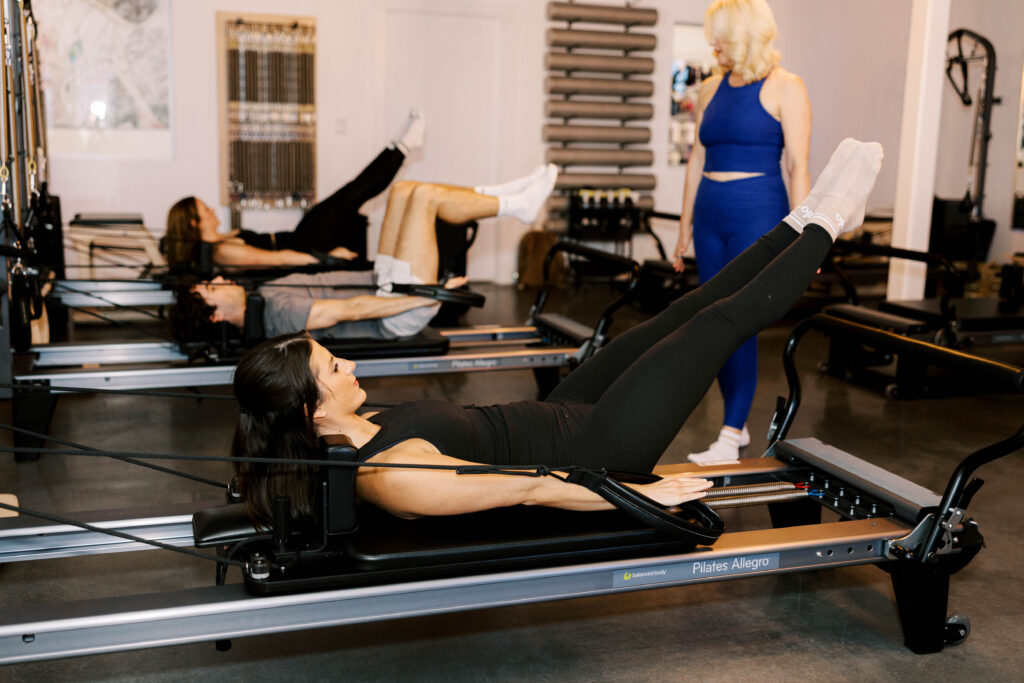
1. Resistance that progresses with you
The reformer’s springs provide resistance as you push, pull, and stabilize its moving carriage. A qualified instructor can change springs, positions, repetitions, and exercise difficulty to create appropriate challenges. More springs do not always mean a harder exercise; sometimes lighter resistance demands greater control. Progress matters more than simply feeling exhausted. Tracking stronger technique, improved endurance, and increasingly challenging movements provides a more useful picture of growth than sweat alone. The American College of Sports Medicine emphasizes that consistent, appropriately prescribed resistance training under the guidance of a qualified instructor can improve muscular strength and size [1]. Reformer workouts can apply those principles, although results depend on the exercises and quality of instruction.
2. Measurable strength benefits across body types
Evidence goes beyond attractive studio photographs. In a 2025 randomized controlled trial published in Scientific Reports, researchers studied 47 women aged 30–60 with a BMI classified as overweight or obese. Participants assigned to eight weeks of reformer Pilates demonstrated improvements in measured upper-body strength and muscular endurance [2]. These findings don’t guarantee identical results for everyone, but they show that reformer training can provide a muscular challenge, including for people who don’t identify as athletic.
3. Strength that supports everyday movement
Strength is useful when carrying groceries or small children, standing from a chair, or navigating uneven sidewalks. In a randomized trial involving adults aged 65 and older at risk for falls, ten weeks of group reformer Pilates improved several measures of balance, functional mobility, and lower-limb range of motion compared with controls [3]. The study assessed movement, not muscle growth, so its findings should be understood accordingly. Still, they illustrate why training coordination alongside muscular effort can matter throughout life, and are even more so important as we age.
4. Modifications instead of one-size-fits-all workouts
A skilled teacher can adjust resistance, range of motion, body position, and exercise selection for a beginner, experienced athlete, or someone with limited mobility. That’s valuable when participants arrive with different needs in a group class. No exercise method is risk-free. However, a Pilates studio with experienced management and instructors can provide effective screening, clear technique cues, and appropriate modifications. These are meaningful safety priorities that also promote sustainability and long-term success.
5. Comprehensive instruction is worth seeking
Look beyond a brief reformer certification. The Pilates Method Alliance specifies a 450-hour comprehensive teacher-training standard that covers anatomy, kinesiology, exercise programming, multiple apparatus, observation, and supervised teaching [4]. Those qualifications don’t automatically guarantee excellent coaching, but they’re useful evidence of preparation. In a randomized study of resistance-trained adults, supervised exercise produced some stronger training adaptations than performing the same program without supervision [5]. That study wasn’t Pilates-specific, but it reinforces the value of attentive coaching. Further, studios that prioritize training and continuing education for their staff will typically provide their clients with a better overall experience than studios with high staff turnover, an underqualified trainer, or staff with little real-world experience adapting group fitness to accommodate an individual’s needs.
6. Choose coaching over choreography
Before joining a studio, try a class. Can the instructor see participants clearly, offer individualized corrections, and adjust movements? Can you hear instructions without competing with pounding music? Is there room to ask questions? A crowded franchise class built around nonstop sweating may be entertaining, but intensity alone doesn’t establish progress. Conversely, an independent studio isn’t automatically better: assess what actually happens during class.
The strongest choice is a genuine reformer studio where comprehensively trained instructors know your goals, monitor technique, and build appropriate challenges over time. You deserve more than a choreographed workout. Choose instruction that helps you leave stronger, more capable, and eager to return. You’ll also gain two welcome benefits: improved confidence and mental well-being.
Sources
- American College of Sports Medicine (2026). Resistance Training Prescription for Muscle Function, Hypertrophy, and Physical Performance.
- Gökalp et al. (2025), Scientific Reports. Effects of Reformer Pilates on Body Composition, Strength, and Psychosomatic Factors in Overweight and Obese Women.
- Pilates Reformer Exercises for Fall Risk Reduction in Older Adults (2018), Journal of Bodywork and Movement Therapies. Read the randomized controlled trial.
- Pilates Method Alliance. Recommended Minimum Standards for Comprehensive Pilates Teacher Training.
- Supervision During Resistance Training Positively Influences Muscular Adaptations in Resistance-Trained Individuals (2023), Journal of Sports Sciences. Read the randomized study.