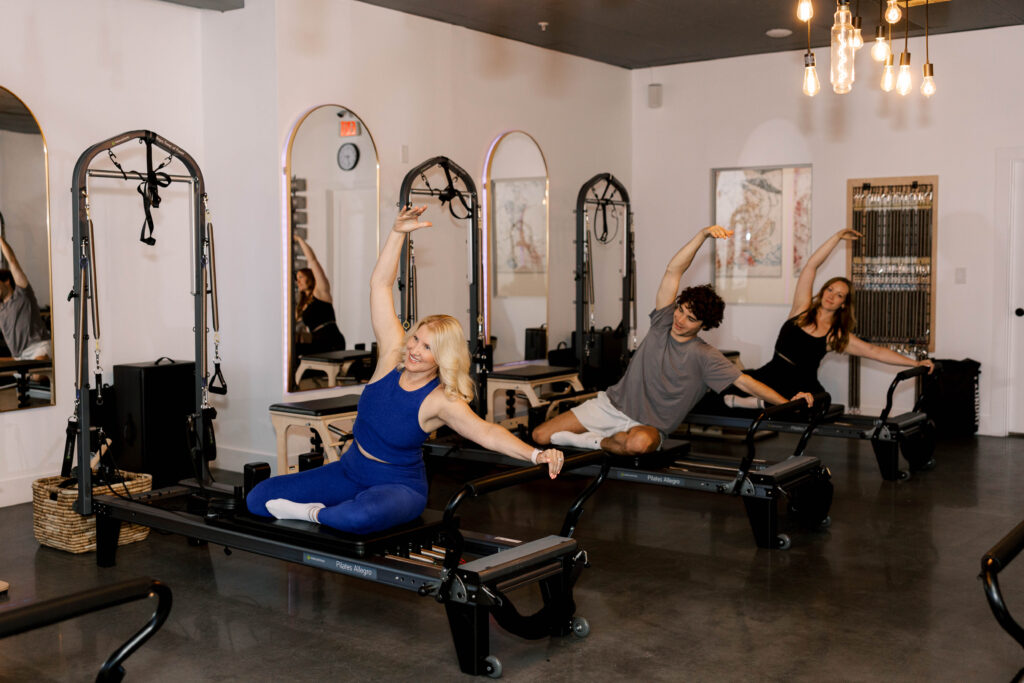
Aging not only affects how we feel mentally and physically, but it also changes how our bodies respond to exercise. Maintaining strength, mobility, and balance becomes increasingly important as we age. For men, it helps prevent injuries, promotes natural testosterone production, and supports a healthy metabolism. For women, it can help lessen the side effects of menopause. Reformer Pilates offers adjustable spring resistance and controlled movement, making it a useful component of a well-rounded fitness program.
1. Builds Strength Without Relying on High-Impact Exercise
The Reformer uses springs to provide resistance, while many exercises are performed lying down, seated, or supported. In a randomized trial of 32 older adults, researchers found that 12 weeks of equipment-based Pilates improved knee muscle strength compared with stretching (Pires-Oliveira et al., 2015). The program used several Pilates apparatuses, including a Reformer, rather than relying exclusively on the Reformer. This supports Pilates as a strength-training option, although results depend on the exercises selected and the resistance used.
2. Helps Maintain Functional Strength as We Age
Muscle function matters for everyday activities, from rising from a chair to navigating stairs. In a randomized trial involving 109 women aged 60 and older, a 12-week Pilates program improved handgrip strength and walking performance, but did not significantly increase skeletal muscle mass (Aibar-Almazán et al., 2022). That distinction matters: gaining strength does not automatically mean gaining muscle size. Older adults seeking to increase muscle mass may also benefit from progressive resistance training, which a comprehensively trained Pilates instructor can program.
3. Complements a Bone-Health and Osteoporosis-Prevention Plan
Bones respond to prescribed mechanical loading. A randomized study reported improvements at some bone sites after six months of Pilates in postmenopausal women (de Oliveira et al., 2019). Evidence does not necessarily establish that Reformer Pilates alone prevents osteoporosis. It can complement medically appropriate weight-bearing and resistance exercise. This can be added to your Pilates workout.
4. Improves Flexibility and Functional Mobility
Stiffness can make movements feel harder. A randomized controlled trial of 55 adults aged 65 to 95 examined weekly group Reformer sessions over ten weeks. Participants improved hip and ankle movement measures and functional mobility compared with a group receiving no intervention (Roller et al., 2018). These findings suggest the Reformer can help maintain usable range of motion. They do not prove that Pilates prevents injuries, of course. However, when done under the supervision of a qualified instructor, safety is maximized during your session.
5. Supports Balance and Fall-Risk Reduction
Balance is central to maintaining independence. In the same Reformer trial, researchers documented improved static and dynamic balance and reduced measured fall risk (Roller et al., 2018). Because the study tracked risk assessments rather than demonstrating fewer fractures, its conclusions should not be overstated. Still, improving balance offers a reason to include supervised movement training in later life.
6. Encourages Postural Control Through Core Strength
Posture involves coordinated muscular control, not simply standing straighter. In a randomized trial comparing Pilates, resistance exercise, and usual activity in women aged 60 to 80, the Pilates group improved hip-extension strength relative to controls, although differences in measured balance were not significant (Carrasco-Poyatos et al., 2019). Reformer exercises can challenge trunk stabilization, but no single class guarantees correction of age-related postural changes.
Putting it all together
The takeaway: Reformer Pilates can be an adaptable, low-impact way to train strength, mobility, and balance. For healthy aging, combine it with other low-impact exercises, such as brisk walking and progressive resistance training, and with individualized instruction tailored to each participant’s abilities, medical history, and goals.
Research sources
All six studies cited in the article are original randomized controlled trials:
- Pires-Oliveira et al. (2015) — Pilates equipment training, muscle strength, and postural balance.
- Aibar-Almazán et al. (2022) — Muscle strength, body composition, and functional performance in older women.
- Watson et al. (2018) — The LIFTMOR trial investigating resistance and impact training for bone density.
- de Oliveira et al. (2019) — Pilates exercise and bone mineral density in postmenopausal women.
- Roller et al. (2018) — Group Reformer Pilates, fall risk, balance, and mobility in older adults.
- Carrasco-Poyatos et al. (2019) — Pilates versus resistance training for trunk strength and balance.