Why More Men Over 40 Are Taking Up Reformer Pilates
For years, reformer Pilates was unfairly viewed as a workout designed mainly for dancers or women. That perception is changing quickly. More men over 40 are turning to reformer Pilates because it addresses the exact issues that often begin to appear with age: joint stiffness, reduced mobility, back pain, slower recovery, poor posture, and nagging injuries from years of weight training or high-impact exercise.
Unlike many traditional fitness programs, reformer Pilates focuses on controlled resistance, core stability, balance, flexibility, and functional strength. Research has shown that Pilates training can improve trunk strength, flexibility, balance, posture, and muscular endurance while placing less stress on the joints. (PMC)
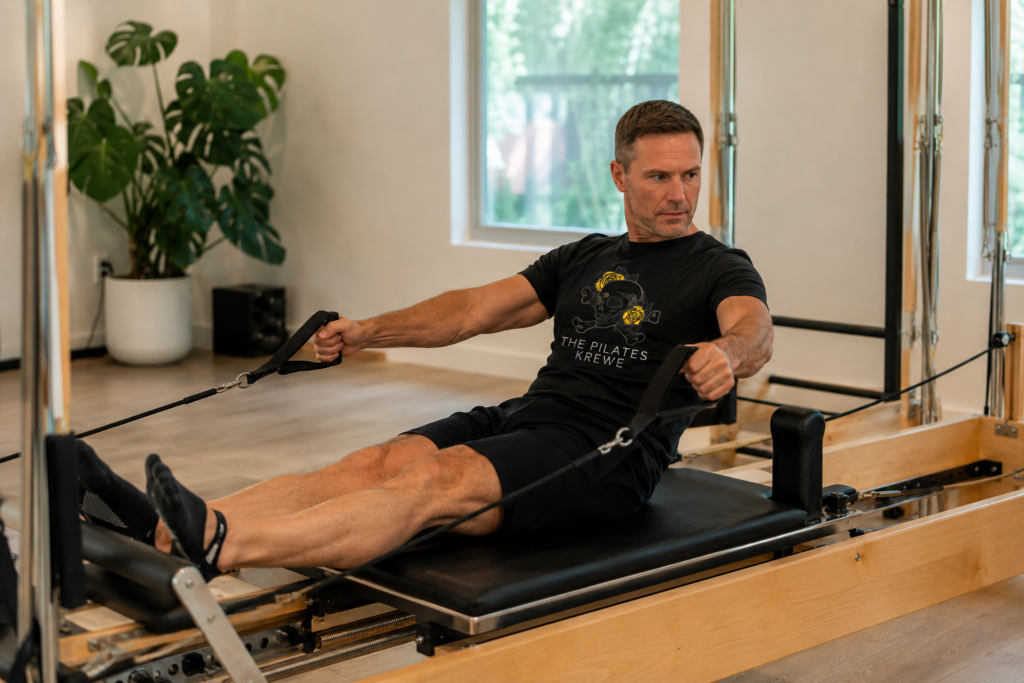
1. Reformer Pilates Builds Functional Strength Without Excess Joint Stress
Many men over 40 still enjoy lifting weights, but years of heavy bench presses, deadlifts, and squats can take a toll on the shoulders, knees, hips, and lower back, while often ignoring smaller, yet equally important muscle groups. Reformer Pilates uses spring-based resistance instead of heavy external loads, allowing muscles to strengthen through controlled movement patterns with significantly less joint compression. Furthermore, it is guided by professional instructors trained in anatomy and kinesiology, providing a framework for safe, sustainable movement.
A study comparing Pilates training to traditional resistance training found that Pilates was especially effective at improving trunk and hip strength, both of which are essential for spinal support and long-term movement quality. (PMC)
This becomes increasingly important with age because recovery capacity changes. Men in their 40s and 50s often notice that heavy lifting sessions leave them sore for days or aggravate old injuries. Reformer Pilates challenges strength and endurance while reducing the wear-and-tear commonly associated with repetitive heavy loading.
That does not mean weight training is “bad.” Strength training still has important benefits for bone density and muscle preservation. However, many men are discovering that reformer Pilates offers a more sustainable way to stay strong, mobile, and athletic long term. (Boston University)
2. Pilates Improves Mobility and Flexibility Better Than Traditional Weight Training
One of the biggest differences between reformer Pilates and conventional gym workouts is the emphasis on mobility and range of motion. Traditional weight training often focuses on isolated muscle groups and shortened movement patterns. Pilates trains the body through longer, controlled ranges of motion that improve flexibility while simultaneously building strength.
Research has linked Pilates training to improved joint mobility, posture, balance, and reduced lower back pain. (Harvard Health)
For men over 40, this matters because tight hips, stiff thoracic spines, and poor shoulder mobility are common contributors to pain and injury. Many clients report that everyday activities — golfing, lifting kids, traveling, playing sports, or even sitting at a desk — become easier after several months of consistent reformer Pilates.
3. Reformer Pilates Is Often Safer Than HIIT Training for Aging Bodies
High-intensity interval training (HIIT) became extremely popular because of its calorie-burning efficiency. But many HIIT workouts involve repetitive jumping, explosive movements, and rapid transitions that can irritate joints or increase injury risk, especially in older adults.
Recent reporting on HIIT research noted that while HIIT can improve conditioning, experts caution that it may aggravate sensitive joints and increase cardiovascular strain in some older participants. (Health)
Reformer Pilates offers many of the same conditioning benefits — muscular endurance, core activation, elevated heart rate, and full-body training — without the pounding impact. Because the reformer supports the body and offers adjustable resistance, exercises can be modified to suit different fitness levels and physical limitations.
Harvard Health also describes Pilates as a low-impact form of exercise that may be especially appropriate for older adults dealing with mobility concerns or joint pain. (Harvard Health)
4. Men Are Discovering That Pilates Is Harder Than They Expected
A common fear among men is that they will not fit in or will struggle during class. In reality, many first-time male clients are surprised by how challenging reformer Pilates actually is. The slow, controlled movements expose weaknesses in stability, balance, flexibility, and core control that traditional gym workouts often overlook.
The good news is that nobody is expected to be perfect on day one. Reformer Pilates is highly adaptable, and instructors routinely modify exercises for beginners, injuries, mobility restrictions, and different fitness backgrounds.
“The key for men is finding the right Pilates studio. Some of the newer franchises have a one-size-fits-all approach to their classes. That means they are teaching the same fitness program to a 22-year-old female as they are to a 46-year-old male.” Says Dan Alexander, co-owner of The Pilates Krewe in Tampa, Florida. He adds, “Classical-based studios like ours not only recognize the difference in fitness needs among these cohorts, but caters to them in the same class by modifying spring loads and layering on challenges as needed.”
More importantly, men are no longer unusual in Pilates studios. Athletes, golfers, runners, former weightlifters, and professionals over 40 are increasingly adding reformer Pilates to their routines because it helps them move better, recover better, and stay active longer.
The first class may feel unfamiliar, but many men quickly realize they are not competing against anyone else in the room. They are simply building a stronger, healthier body that can continue performing well for decades to come.