A well-run group reformer Pilates class does not simply deliver choreography that makes you sweat and feel it in places you didn’t know you had muscles—it applies movement as a form of individualized, adaptive training. This distinction becomes critical when working with clients who present with injuries, chronic conditions, or movement limitations. In that context, the ability to modify exercises is not a luxury; it is a core competency that directly impacts safety, outcomes, and client retention. The problem is, most group reformer classes don’t provide this level of personalization.
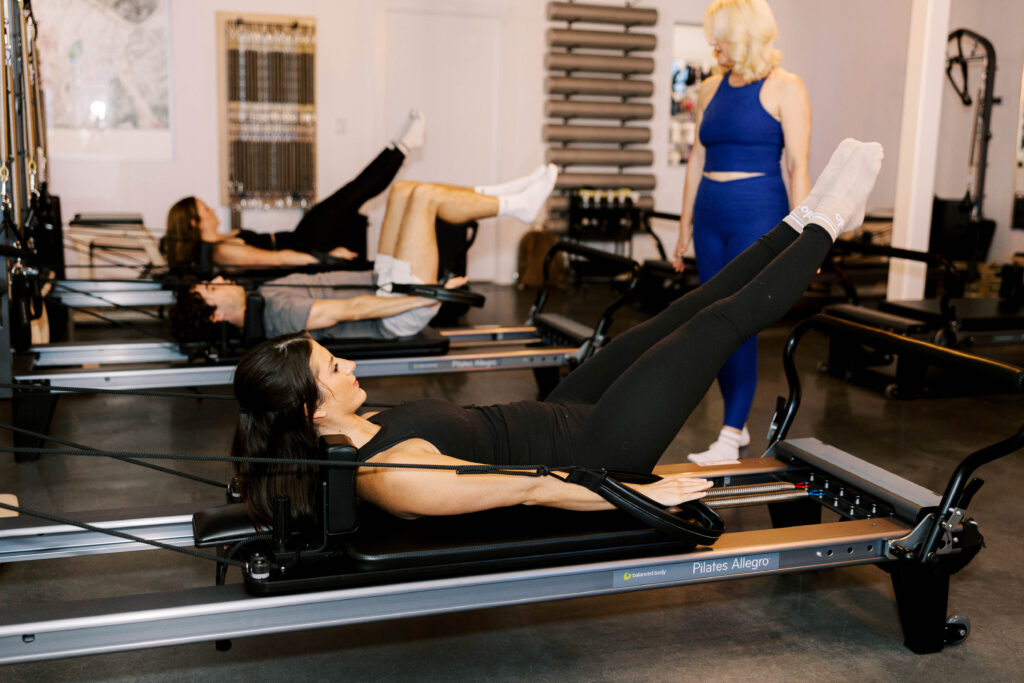
Research consistently shows that Pilates can reduce pain and improve function in people with musculoskeletal conditions, limited mobility, and prior injury, but outcomes vary significantly depending on how the exercises are prescribed and executed. (ScienceDirect) This variability underscores a key point: Pilates is not inherently therapeutic unless it is applied with precision. A 2024 review noted that exercise dosage, frequency, and execution differ widely across individuals, particularly in injury contexts, reinforcing the need for tailored programming rather than standardized routines. (PMC)
Few reformer Pilates studios, especially those that are mass-market, like the franchised studios popping up across the suburbs, are equipped to provide this tailored approach to classes. And even fewer have the staff with proper qualifications to do so.
The reformer itself introduces both opportunity and risk. Its adjustable springs and guided motion can support rehabilitation and scalability, but improper use or poor instruction increases the likelihood of strain or injury. (Medical News Today) This is especially relevant in group settings, where instructors must manage multiple bodies with different needs simultaneously. Industry guidance suggests limiting class sizes and avoiding high-risk movements for less experienced participants to maintain safety (EMD UK). Yet, mass-market franchises have profit-driven models that require large classes, often with 12 or more clients at a time.
A “one-size-fits-all” group reformer class fundamentally conflicts with how the human body operates. Individuals differ in joint mobility, injury history, neuromuscular control, and tolerance to load. As one physical therapy-based source explains, “Most workout programs are built for the masses… Spoiler alert: they don’t [fit everyone].” (Ask My PT) This insight aligns with broader exercise science: programs that ignore individual biomechanics often produce suboptimal results or increase injury risk.
From a practical standpoint, failure to modify exercises can place clients in compromised positions—particularly on a reformer, where spring tension, alignment, and transitions must be carefully managed. Experts warn that incorrect setup or execution can lead to falls, strain, or instability-related injuries. (IDEA Health & Fitness Association) In contrast, a skilled instructor can regress or progress movements, adjust resistance, and cue alignment in real time, ensuring that each participant works within an appropriate intensity and range.
“Our staff at The Pilates Krewe is trained to do just that – understand client needs and adjust programs on the fly. We personally know each client – even in the group setting – and if they require modifications due to prior injury, rotational restrictions, illness, or even pregnancy. We don’t permit strangers to drop into a class unannounced, using an app like ClassPass, or signing up without being screened. To do so is a huge disservice to the individual, exposing them to unnecessary risk of injury. It also disrupts the flow of a class for our existing members and the instructor,” explains Sydney Soschin, founder of The Pilates Krewe, where all staff hold elite certifications, making them qualified to provide a more tailored and necessary approach to group fitness.
Ultimately, the value of a Pilates studio lies in its ability to meet clients where they are. Group classes can be highly effective, but only when they are coached with an individualized lens. Studios that rely on rigid, pre-set sequences without accommodating injuries or limitations are not delivering Pilates in its intended form—they are delivering choreography. For most clients, especially those managing pain or recovering from injury, that distinction matters.